
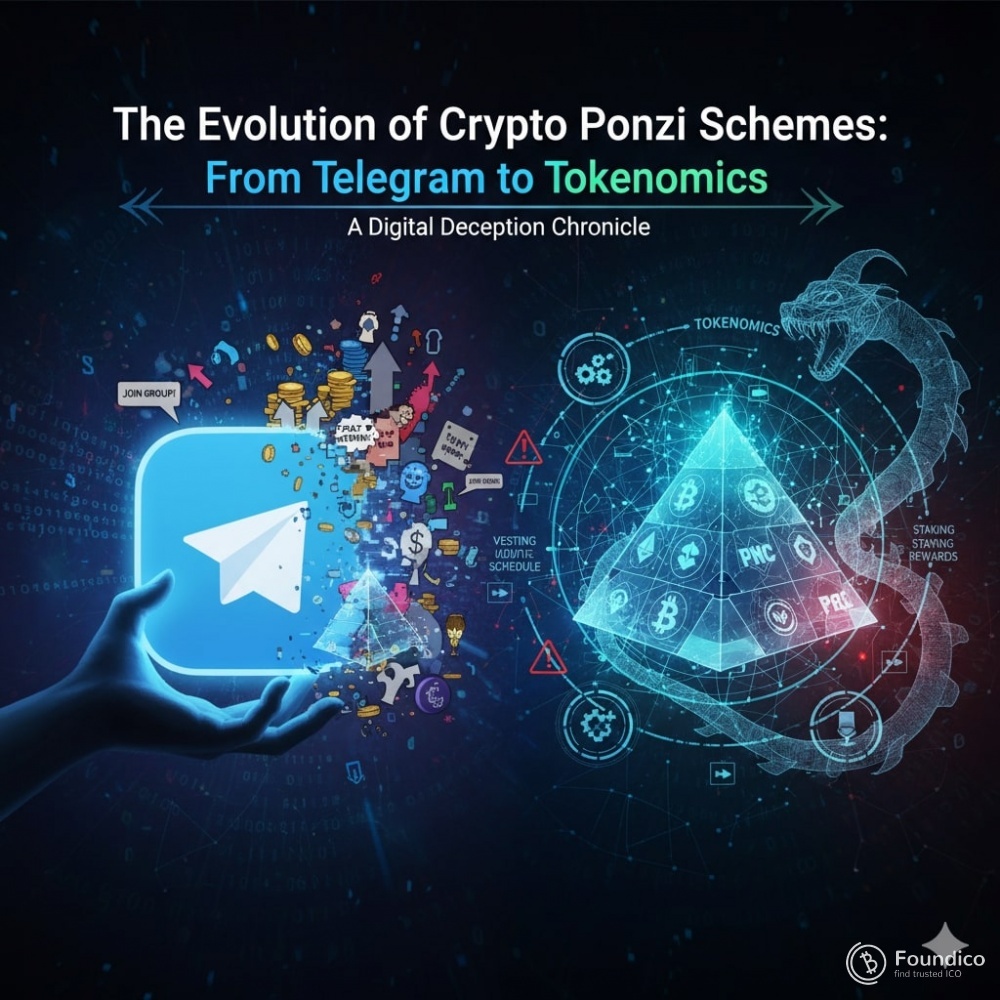
The Evolution of Crypto Ponzi Schemes: From Telegram to Tokenomics
By Dr. Pooyan Ghamari, Swiss Economist and Visionary
The Classic Blueprint: Promise, Pump, Panic
Ponzi schemes predate crypto by a century, but the blockchain era supercharged them. Early scams followed a predictable script: a charismatic founder promises outsized returns, early entrants get paid from latecomers’ money, hype spreads virally, and the structure collapses when inflows dry up. What changed wasn’t the fraud—it was the medium, the scale, and the sophistication.
Phase 1: Telegram and the ICO Gold Rush (2017–2018)
The first crypto Ponzis rode the ICO wave. Projects raised millions in hours with whitepapers thinner than cocktail napkins. Telegram groups became the new boiler rooms—24/7 chat channels where admins banned skeptics and pumped “to the moon” narratives.
- Bitconnect: The poster child. Lenders earned 1% daily through a “trading bot.” Reality: new deposits paid old ones. At peak, $2.6 billion circulated before the 2018 crash.
- OneCoin: A centralized “crypto” with no blockchain. Sold via MLM seminars in 200 countries, raking in $4 billion before founders vanished.
These were crude: fake volume on ghost exchanges, rented Lambos for YouTube thumbnails, and referral bonuses that screamed pyramid.
Phase 2: Yield Farming and DeFi Degeneracy (2020–2021)
DeFi turned Ponzis into code. Smart contracts automated the fraud, lending legitimacy through “audits” and GitHub repos. Yield farming—staking tokens to earn more tokens—became the perfect cover.
- SushiSwap Fork Frenzy: Copy-paste protocols launched “food coins” with 1,000,000% APY. Early farmers drained liquidity pools; latecomers held worthless governance tokens.
- Titan/IRON Finance: A “partially algorithmic” stablecoin that crashed from $2 to $0 in hours when whales exited. Mark Cuban lost millions; retail lost everything.
The trick? Inflationary token emissions masked as “rewards.” Users thought they were farming yield; they were funding a slow-motion exit liquidity event.
Phase 3: Tokenomics as Theater (2022–Present)
Modern Ponzis don’t hide—they brand. “Sustainable tokenomics” replaced “guaranteed returns.” Whitepapers now feature:
- Vesting cliffs for team tokens (to signal alignment).
- Buyback-and-burn mechanisms (to fake scarcity).
- Revenue sharing from non-existent products.
The game is narrative longevity. Projects launch with:
- Metaverse land no one visits.
- Play-to-earn games where tokens pay salaries.
- Cross-chain bridges that funnel funds to dev wallets.
Terra/LUNA was the masterpiece: an “algorithmic stablecoin” backed by a sister token that promised 20% yields via Anchor Protocol. At its peak, $40 billion flowed in. When the peg broke, $1 trillion in crypto market cap evaporated in a week. Do Kwon fled to Serbia; the code was open-source.
Phase 4: The AI-Powered Ponzi (2024–)
Today’s scams use generative AI for marketing at scale. Chatbots run Telegram groups. Deepfake founders give keynote speeches. Smart contracts auto-generate “roadmap updates” and fake audit reports.
New tropes:
- Soulbound tokens to lock in “loyal” investors.
- Dynamic staking that increases APY as TVL grows (classic Ponzi math).
- NFT fractionalization to sell the same asset to thousands.
The exit is cleaner: devs deploy “migration contracts” that drain old tokens into new ones, resetting the clock.
Red Flags in the Tokenomics Era
Sophisticated or not, every Ponzi leaves fingerprints:
- Unsustainable yield sourced from new capital, not revenue.
- Locked liquidity controlled by multisig wallets with anonymous signers.
- Team allocations vesting over 6 months while promising 5-year vision.
- Marketing budgets larger than product development.
- Referral programs paying 10–30% for recruitment.
Tools like TokenSniffer and RugDoc now score contracts for risk, but hype still blinds.
Why They Keep Working
Crypto Ponzis thrive on three human weaknesses:
- Greed: 100x returns in DeFi beat 5% in a savings account.
- FOMO: Watching others cash out triggers panic buying.
- Complexity: Most users can’t read Solidity code or understand bonding curves.
Add leverage—100x perpetuals on dying tokens—and losses compound.
The Regulatory Reckoning
SEC and DOJ now treat token launches like securities offerings. Founders face:
- Howey Test scrutiny: if a token promises profits from others’ efforts, it’s a security.
- Wire fraud charges for fake revenue claims.
- Asset freezes via court orders to exchanges.
Yet offshore entities and privacy chains keep new scams birthing daily.
The Antidote: Radical Transparency
Sustainable projects counter with:
- On-chain revenue (fees, not inflation).
- Immutable audits embedded in contracts.
- Public team identities and escrowed funds.
- Capped emissions with hard-coded sinks.
The best defense remains user skepticism: if the yield can’t be explained in one sentence without the word “tokenomics,” it’s probably a scam.
Conclusion: Same Game, New Skin
Crypto Ponzis have evolved from Telegram hype to tokenomics theater, but the core remains unchanged: returns for early birds, rugs for the rest. Technology didn’t kill the scam—it scaled it, automated it, and globalized it.
The only lasting protection is financial literacy. In a space where anyone can mint a billion tokens in ten minutes, the oldest rule still applies: if it sounds too good to be true, it’s already draining your wallet.