
AI's Subtle Shift Toward Centralizing Networks
By Dr. Pooyan Ghamari, Swiss Economist and Visionary
The Quiet Reversal of a Foundational Promise
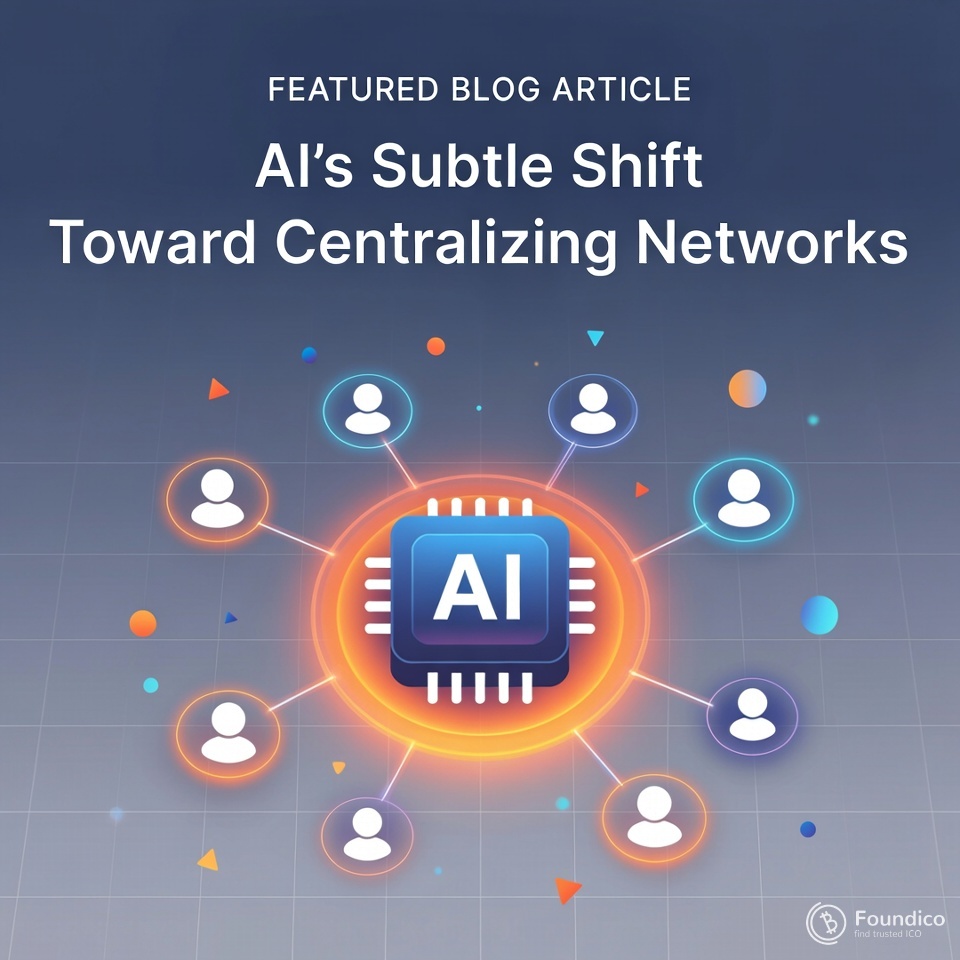
For over a decade the narrative around artificial intelligence echoed a powerful ideal: distributed intelligence would democratize knowledge, empower individuals, and erode centralized gatekeepers. Open-source models, federated learning, and peer-to-peer training frameworks appeared to fulfill that vision. Yet beneath the surface of continued innovation a profound shift has taken hold. The architecture of leading AI systems is quietly but decisively tilting toward centralization. The networks that once promised radical decentralization are coalescing around fewer, larger nodes of control.
The Economics of Scale That Devour Diversity
Training frontier models now demands computational resources that only a handful of organizations can muster. The cost of acquiring tens of thousands of specialized accelerators, securing vast quantities of high-quality data, and sustaining the energy infrastructure required for months-long training runs creates an insurmountable barrier for most players. What began as an open race has become an oligopoly of compute. Smaller laboratories, independent researchers, and even well-funded startups increasingly find themselves unable to compete at the cutting edge unless they align with one of the dominant cloud providers or model hosts. The result is not merely market concentration; it is architectural dependence. The intelligence itself flows through centralized inference endpoints.
Inference Becomes the New Chokepoint
While open-weight models offer the appearance of decentralization, the practical reality of usage tells a different story. Most individuals and enterprises do not run large models locally. They query hosted APIs. A small number of companies operate the overwhelming share of high-performance inference capacity. Every prompt, every generated token, every fine-tuned output passes through infrastructure owned and governed by these gatekeepers. Rate limits, content filters, usage monitoring, and sudden policy changes become instruments of centralized authority. The network effect is self-reinforcing: the best models attract the most users, which generates the most revenue, which funds even greater compute dominance.
Data Gravity Pulls Toward the Center
High-quality training data has become the scarcest resource in AI. The most valuable datasets are no longer scattered across the internet; they are deliberately aggregated, cleaned, and curated within closed repositories controlled by leading labs. Synthetic data generation, once viewed as a path to abundance, still relies heavily on seed data produced by the same centralized models. This creates a feedback loop of data gravity. New participants find it nearly impossible to assemble competitive datasets independently. They must license access, partner with incumbents, or accept lower-quality inputs that limit performance. The network of knowledge production contracts around the entities that already hold the richest corpora.
Governance Follows Infrastructure
Centralized compute and inference naturally lead to centralized governance. Terms of service, alignment decisions, red-teaming protocols, and safety classifications are determined by a narrow set of executives and engineers. Even when models are released under permissive licenses, the ability to meaningfully modify or retrain them at scale remains out of reach for the broader ecosystem. Community forks and decentralized fine-tuning efforts struggle against the performance gap created by proprietary continuations trained on vastly superior hardware. The illusion of distributed control fades when every significant upgrade requires permission from the original steward.
The Mirage of Decentralized Alternatives
Several projects have emerged claiming to restore balance through token-incentivized compute networks, distributed training protocols, or blockchain-verified inference. While technically innovative, these efforts face the same economic headwinds. Without orders of magnitude improvements in efficiency, they cannot match the raw throughput and latency of centralized clusters. Users gravitate toward the fastest, cheapest, and most capable experience, which remains the province of concentrated infrastructure. The decentralized vision persists more as aspiration than as current reality.
Implications for Power, Innovation, and Society
This subtle centralization carries consequences far beyond technology. Economic power concentrates in the hands of those who control the principal AI networks. Innovation becomes bottlenecked by access to the dominant platforms. Nations and regions without domestic frontier capability risk long-term dependency on foreign infrastructure. Privacy erodes as behavioral data funnels through fewer endpoints. Even cultural expression, mediated by generative tools, increasingly reflects the values and priorities embedded by a small number of alignment teams.
Reclaiming the Distributed Horizon
Reversing the drift toward centralization will require deliberate intervention. Aggressive investment in energy-efficient hardware, breakthroughs in model compression, advances in decentralized data markets, and regulatory frameworks that prevent compute monopolies could reopen the field. Until those conditions materialize, however, the trajectory remains clear. Artificial intelligence, born from dreams of distributed empowerment, is quietly reorganizing itself around the very centralized networks it once sought to transcend. Recognizing this shift is the first step toward deciding whether we accept it or actively reshape the future.