
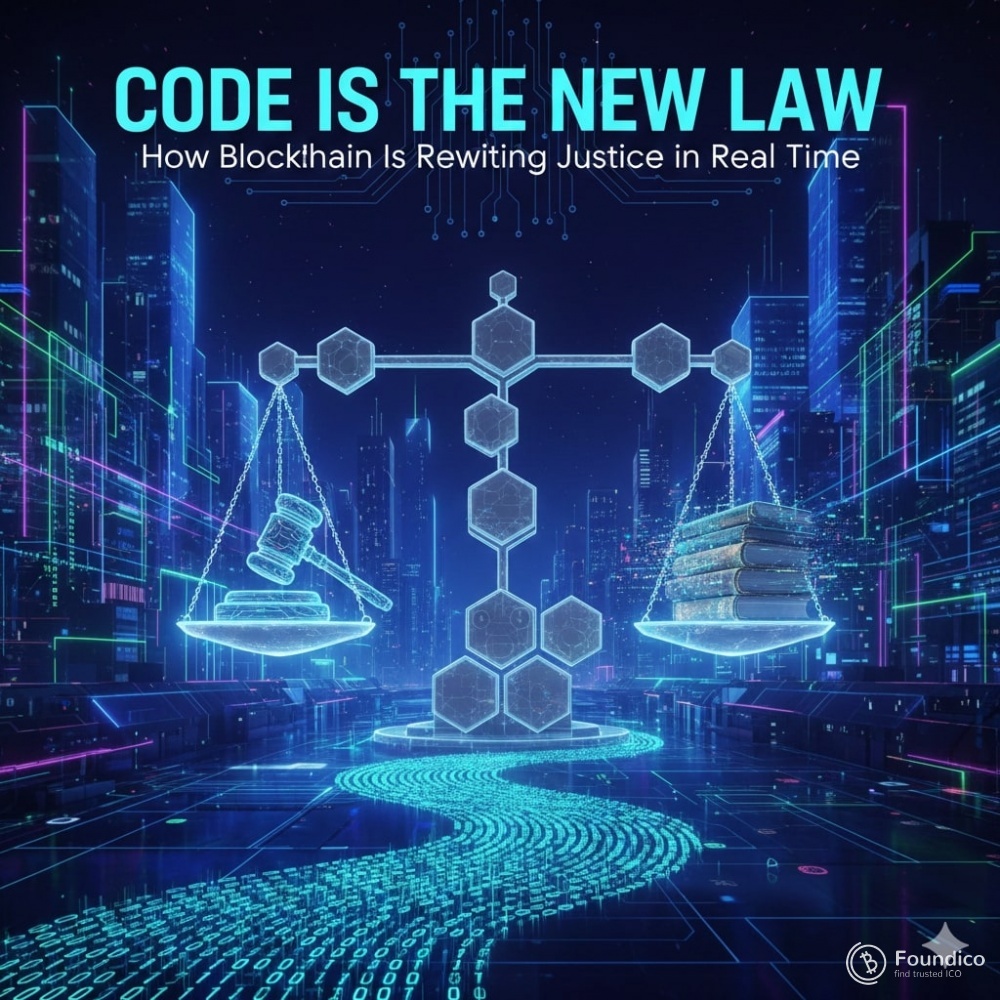
Code Is the New Law: How Blockchain Is Rewriting Justice in Real Time
By Dr. Pooyan Ghamari, Swiss Economist and Visionary
The Quiet Revolution Nobody Saw Coming
While politicians argue about court backlogs and lawyers bill by the hour, an entirely new legal system is already live, running 24/7 on millions of computers worldwide. It doesn’t have marble buildings or black robes. It has cryptography, consensus algorithms, and zero tolerance for human delay. It’s called blockchain, and it is quietly making most of what we call “the justice system” obsolete.
Smart Contracts: The Self-Enforcing Promise
Forget the 50-page PDF nobody reads. A smart contract is a promise that enforces itself.
You deliver the software → you get paid. Instantly. The ship docks on time → insurance premium drops automatically. The renter pays late → the smart lock disables their key fob at midnight. No phone calls. No eviction notices. No judge.
This is not “digital signing.” This is digital obedience.
From Trust to Proof: The Biggest Power Shift in 800 Years
Since 1215, justice has required trusting humans and institutions. Blockchain replaces trust with mathematics. Every transaction, every condition, every breach is recorded forever in tamper-proof ledgers.
Result? The most common courtroom fights— “he said, she said,” “I never received it,” “the check is in the mail”—simply cease to exist. The blockchain already knows what happened. Arguing with facts is now as pointless as arguing with gravity.
The Rise of Jurors Who Never Sleep
Decentralized justice platforms are already operational. Real money, real disputes, real rulings—decided by crowds of anonymous token holders who stake their crypto on being correct. Get it right, earn fees. Get it wrong, lose your stake.
It sounds insane until you realize it’s more accountable than many lifetime-appointed judges. Platforms like Kleros have resolved thousands of cases faster and cheaper than any small-claims court on Earth. The future is not waiting for permission.
Governments Are Racing, Not Resisting
Switzerland, Singapore, Estonia, Dubai, and Wyoming are not “experimenting” with blockchain law—they are fighting to own it. Legislative bodies worldwide have already declared:
- Smart contracts are legally binding
- Blockchain records can serve as evidence
- Digital signatures written in code satisfy centuries-old requirements of “writing” and “signature”
The law is not being dragged into the future. It’s sprinting to stay relevant.
The Inconvenient Truth About “Code Is Law”
Code can be more ruthless than the strictest judge. One missing semicolon, one logic flaw, and hundreds of millions can vanish forever. Immutability is a feature until it’s a catastrophe.
The next decade will crown a new elite: legal engineers who write million-dollar clauses in Solidity and Rust instead of Latin and legalese. We’d better hope they care about fairness more than fees.
Justice Without Borders, Passports, or Patience
One blockchain. Seven billion potential enforcers.
A freelancer in Manila gets paid before the client in Munich finishes coffee. A solar farmer in Morocco receives carbon credits the instant her panels generate power. A Ukrainian refugee proves ownership of her Kyiv apartment with a private key—no paperwork, no bureaucracy, no bribes.
This is the ultimate endgame: a global legal layer that works the same way in Lagos as it does in London.
The Verdict Is Already Executed
The fusion of law and code is the most profound shift in power since the printing press democratized knowledge. Courts will not disappear, but they will be reserved for the truly hard cases—while 90% of everyday justice runs on autopilot, cheaper, faster, and often fairer than humans ever managed.
The future is not coming. It went live years ago. The only question left: will we master the code, or will the code master us?
Dr. Pooyan Ghamari Swiss Economist and Visionary