
How AI Amplifies Social Engineering Tactics
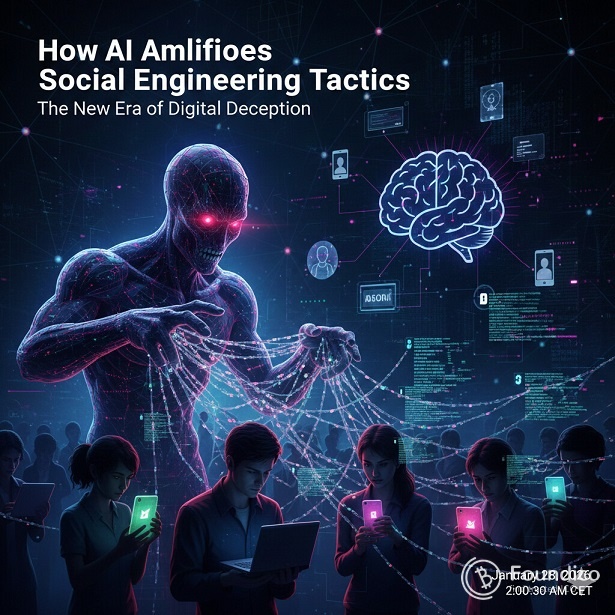
By Dr. Pooyan Ghamari, Swiss Economist and Visionary
The Dawn of Digital Deception
In an era where technology intertwines with every aspect of human interaction, artificial intelligence emerges as a double-edged sword. While it promises unparalleled efficiency and innovation, it also equips malicious actors with tools to refine age-old tactics of manipulation. Social engineering, the art of exploiting human psychology to gain unauthorized access or information, finds a powerful ally in AI. This alliance not only scales deceptive practices but also makes them more sophisticated and harder to detect.
Imagine a world where scams adapt in real time to your behavior, where voices and faces can be fabricated with eerie precision. AI does not just assist in these endeavors; it transforms them into widespread threats that challenge our notions of trust and security. As we delve deeper, we uncover how this technology breathes new life into manipulative strategies.
Phishing Reimagined: AI's Cunning Bait
Traditional phishing relies on generic emails or messages designed to trick recipients into revealing sensitive data. With AI, these attempts evolve into personalized assaults tailored to individual vulnerabilities. Algorithms analyze vast datasets from social media, browsing histories, and public records to craft messages that mimic familiar tones and contexts.
For instance, an AI system might generate an email that appears to come from a trusted colleague, referencing recent events or shared interests to build credibility. This level of customization increases success rates dramatically, turning what was once a scattershot approach into a precision strike. The result? Organizations and individuals face a barrage of convincing lures that exploit emotional triggers like urgency or fear.
Deepfakes: Forging Realities That Fool the Eye
One of the most alarming advancements involves deepfake technology, where AI manipulates audio and video to create lifelike impersonations. Social engineers leverage these fabrications to impersonate executives, family members, or public figures, coercing victims into actions they would otherwise avoid.
Picture a video call where a CEO's likeness instructs an employee to transfer funds urgently. The realism afforded by AI makes skepticism rare, leading to significant financial losses or data breaches. Beyond immediate harm, deepfakes erode societal trust, making it challenging to discern truth from fabrication in an increasingly digital world.
Bots Unleashed: The Army of Automated Persuaders
AI-driven bots represent another frontier in amplified social engineering. These programs simulate human conversation across platforms, from social networks to customer service chats, to extract information or spread misinformation. Unlike human operators, bots operate tirelessly, engaging multiple targets simultaneously with adaptive responses.
Such automation allows for large-scale campaigns that influence public opinion or harvest personal details under the guise of innocuous interactions. By learning from each exchange, these bots refine their tactics, becoming more persuasive over time. The sheer volume and persistence they offer turn isolated incidents into pervasive threats.
The Ethical Crossroads: Balancing Innovation and Integrity
As AI continues to enhance social engineering capabilities, society stands at a critical juncture. Developers and policymakers must grapple with the responsibility of creating safeguards without stifling progress. Ethical AI frameworks, robust verification systems, and public awareness campaigns emerge as essential countermeasures.
Yet, the allure of these tools for both good and ill underscores a fundamental question: How do we harness AI's potential while mitigating its risks? Education plays a pivotal role, empowering individuals to recognize and resist manipulative tactics amplified by technology.
Forging a Resilient Future
The amplification of social engineering through AI signals a paradigm shift in cybersecurity and human interaction. By understanding these mechanisms, we can develop proactive defenses that outpace evolving threats. From advanced detection algorithms to fostering a culture of vigilance, the path forward demands collaboration across sectors.
In the end, AI's role in social engineering serves as a reminder of technology's profound impact on society. As we navigate this landscape, wisdom and foresight will determine whether we succumb to deception or rise above it, securing a future where trust prevails.