
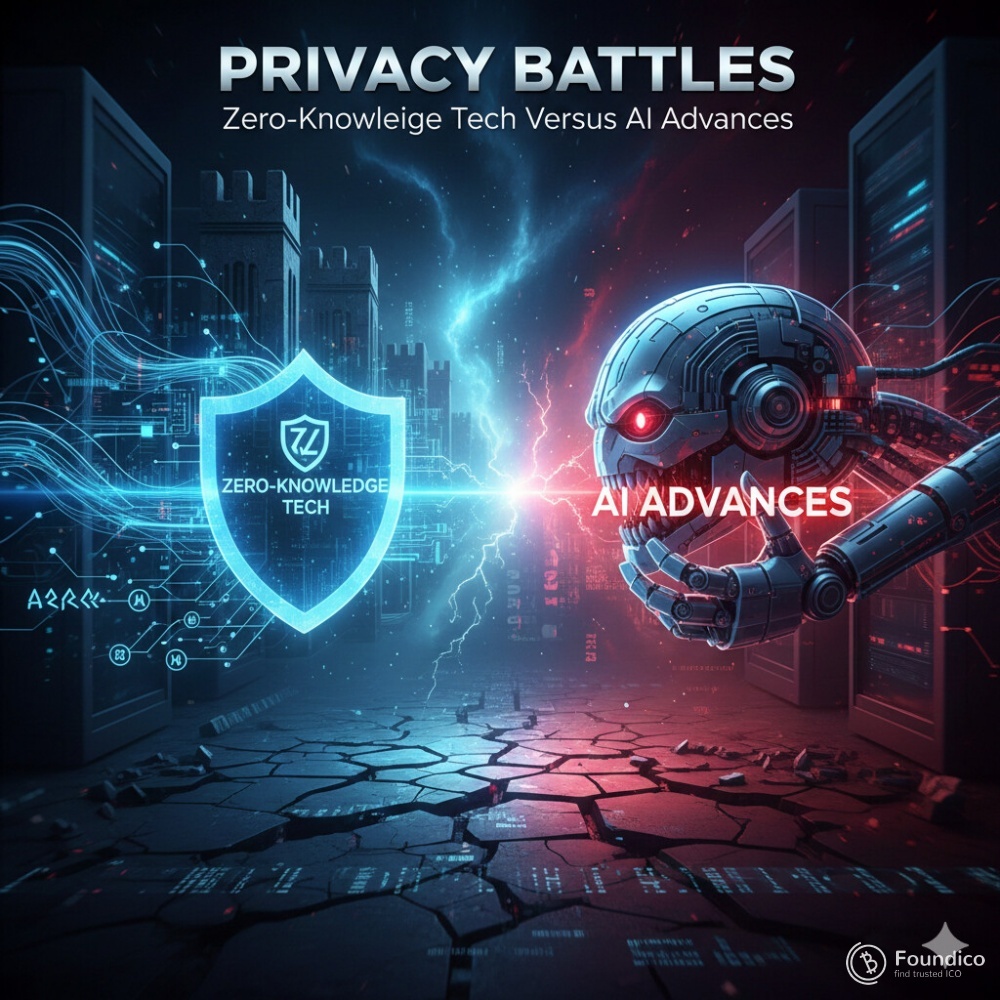
Privacy Battles: Zero-Knowledge Tech Versus AI Advances
By Dr. Pooyan Ghamari, Swiss Economist and Visionary
In an era where data fuels innovation, the clash between safeguarding personal information and pushing the boundaries of artificial intelligence has never been more intense. Zero-knowledge technology emerges as a guardian of privacy, while AI's relentless pursuit of knowledge challenges the very foundations of secrecy. This article delves into the heart of this digital tug-of-war, exploring how these forces shape our future.
The Silent Guardians: Unveiling Zero-Knowledge Wonders
Zero-knowledge proofs stand as cryptographic marvels, allowing one party to prove knowledge of a fact without revealing the fact itself. Imagine verifying your age to enter a venue without showing your birthdate, or confirming a transaction's validity without exposing details. This technology, rooted in mathematical elegance, empowers users to maintain control over their data in an increasingly interconnected world.
Developed in the 1980s by pioneers like Shafi Goldwasser and Silvio Micali, zero-knowledge systems have evolved into practical tools. Blockchain platforms such as Zcash and Ethereum integrate them to enable private transactions amid public ledgers. The beauty lies in their ability to foster trust without transparency, a paradox that redefines security in digital ecosystems.
Yet, as these guardians rise, they face formidable opponents in the realm of AI, where data is the lifeblood of progress.
The Data Devourers: AI's Insatiable Hunger for Information
Artificial intelligence thrives on vast datasets, learning patterns and making predictions that revolutionize industries from healthcare to finance. Machine learning models, like those powering recommendation engines or autonomous vehicles, require immense amounts of personal data to achieve accuracy. Without this fuel, AI's potential dims, leading to calls for more open data sharing.
However, this hunger raises alarms. AI systems often process sensitive information, from medical records to browsing habits, risking breaches and misuse. Regulations like GDPR in Europe attempt to curb excesses, but the pace of AI advancement outstrips legal frameworks. Innovators argue that privacy constraints could stifle breakthroughs, such as personalized medicine or predictive analytics that save lives.
In this landscape, zero-knowledge tech offers a bridge, potentially allowing AI to glean insights without direct access to raw data.
Clash of Titans: Where Privacy Meets Progress
The battlefield emerges in applications demanding both secrecy and intelligence. Consider decentralized finance, where zero-knowledge proofs secure transactions, yet AI algorithms analyze market trends for investment advice. Balancing these requires innovative hybrids, like homomorphic encryption, which lets computations occur on encrypted data.
Challenges abound. Implementing zero-knowledge in AI workflows increases computational overhead, slowing processes that demand speed. Moreover, not all data can be anonymized effectively; some AI tasks rely on contextual nuances that privacy tools might obscure.
Visionaries foresee a symbiotic future. Federated learning, where models train across devices without centralizing data, pairs well with zero-knowledge methods. This approach could enable collaborative AI development while preserving individual privacy, turning adversaries into allies.
Economic Ripples: The Cost of Concealment Versus Revelation
From an economic standpoint, the tension influences global markets. Companies investing in zero-knowledge tech position themselves as privacy champions, attracting users wary of data scandals. Conversely, AI giants like those in Silicon Valley push for data liberalization to maintain competitive edges.
Nations grapple with policy decisions. Switzerland, known for banking secrecy, explores zero-knowledge integrations in fintech, while AI hubs like the United States prioritize innovation. The outcome could reshape economic power, favoring regions that master this balance.
Investors watch closely. Startups blending these technologies attract funding, promising solutions that comply with emerging privacy laws without sacrificing AI capabilities.
Future Horizons: Navigating the Privacy-AI Nexus
As we peer ahead, the evolution of this battle hinges on collaboration. Researchers must develop scalable zero-knowledge frameworks that integrate seamlessly with AI architectures. Policymakers need to craft regulations that encourage innovation while protecting rights.
Individuals play a role too, demanding tools that empower rather than exploit. Education on these technologies will demystify the debate, fostering informed choices in a data-driven society.
In conclusion, the privacy battles pitting zero-knowledge tech against AI advances are not zero-sum games. Through ingenuity and ethical foresight, we can harness both to build a world where progress and privacy coexist harmoniously.