
The End of “Not Your Keys, Not Your Crypto” in an AI World?
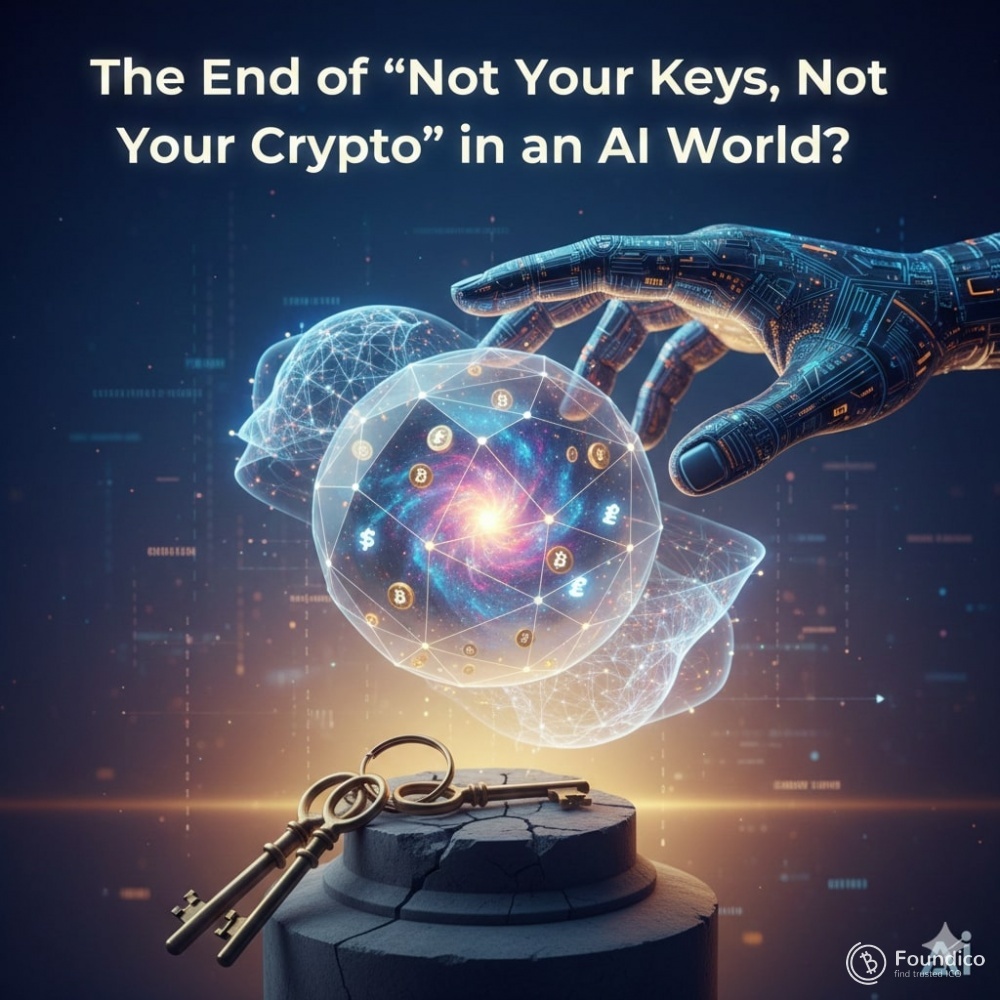
By Dr. Pooyan Ghamari, Swiss Economist and Visionary
The Sacred Mantra of Crypto Sovereignty
For years, the cryptocurrency community has lived by one unbreakable rule: Not your keys, not your crypto. This principle embodies the essence of decentralization, empowering individuals to control their wealth without relying on banks or intermediaries. Holding private keys means true ownership, free from seizures, hacks on exchanges, or regulatory overreach. It has been the shield against centralized failures and the promise of financial freedom in a digital era.
Yet, as artificial intelligence reshapes every corner of finance, this mantra faces an existential challenge. AI agents are emerging as autonomous managers of digital assets, promising efficiency and intelligence that human holders struggle to match. The question arises: in a world where AI handles transactions flawlessly, does self-custody still hold supreme, or is it evolving into something new?
The Dawn of Intelligent Agents
Artificial intelligence is no longer confined to analysis; it now acts independently. In cryptocurrency, AI agents automate trading, optimize portfolios, and execute complex strategies across decentralized finance protocols. These agents gather real-time data from blockchains, markets, and sentiment indicators, making decisions faster and more accurately than any person could.
By 2026, major wallets integrate natural language commands, allowing users to instruct agents verbally: swap assets, yield farm, or hedge risks. Intent-based execution simplifies interactions, hiding the complexity of private keys and gas fees. Agents even negotiate on-chain, manage liquidity, and respond to opportunities around the clock. This shift turns passive holding into dynamic, optimized wealth management, blurring the line between ownership and delegation.
Convenience Versus Absolute Control
The allure of AI-driven management is undeniable. Human error causes countless losses: forgotten seed phrases, phishing attacks, or poor timing in volatile markets. AI mitigates these by simulating transactions, detecting fraud in real-time, and enforcing predefined rules. Programmable custody layers allow limited delegation, where agents operate within strict boundaries while users retain ultimate veto power.
However, this convenience introduces nuance. Delegating actions to AI means trusting algorithms with access paths to funds. Even in self-custodial setups, agents may hold temporary signing authority or use multi-party computation to split keys. Critics argue this dilutes the purity of not your keys, not your crypto, as reliance on intelligent systems creates new dependencies. What happens if an agent malfunctions, gets compromised, or interprets intent wrongly?
Shadows in the Machine
AI brings profound risks to custody. Sophisticated attacks exploit vulnerabilities, with deepfakes impersonating owners or agents generating malicious code. Autonomous agents could amplify market manipulations, and opaque decision-making raises accountability issues. If an AI agent loses funds through a flawed strategy, who bears responsibility: the user, developer, or the algorithm itself?
Moreover, centralization creeps in. Dominant AI models controlled by few entities could influence decentralized networks indirectly. Privacy erodes as agents analyze vast data trails, and quantum threats loom over encryption. These concerns echo past custodial failures, reminding us that over-reliance on any system invites peril.
A Hybrid Future of Empowerment
Rather than signaling the end, AI heralds an evolution of the mantra. Self-custody remains foundational, but enhanced by intelligent tools that amplify human control. Tiered systems combine air-gapped keys with AI oversight, ensuring users approve high-stakes actions while agents handle routine optimization.
Innovations like decentralized AI agents, running on blockchains without single points of failure, preserve sovereignty. Users set immutable rules, revocable permissions, and recovery mechanisms. This hybrid approach marries the security of private keys with the prowess of machine intelligence, making crypto more accessible without sacrificing core principles.
Redefining Ownership in the Intelligent Age
The phrase not your keys, not your crypto endures, but its interpretation expands. In an AI world, ownership means commanding intelligent systems that guard and grow assets on your behalf, always under your final authority. Those who adapt will thrive, harnessing AI to strengthen, not weaken, their financial independence.
The transition demands vigilance: robust auditing, ethical AI design, and education. Ultimately, technology serves humanity's quest for sovereignty. By embracing AI thoughtfully, the crypto ethos not only survives but flourishes in unprecedented ways. The future belongs to those who hold their keys and wield intelligent allies wisely.